7 Mistakes Small Businesses Make with Digital Strategy (and How to Fix Them)
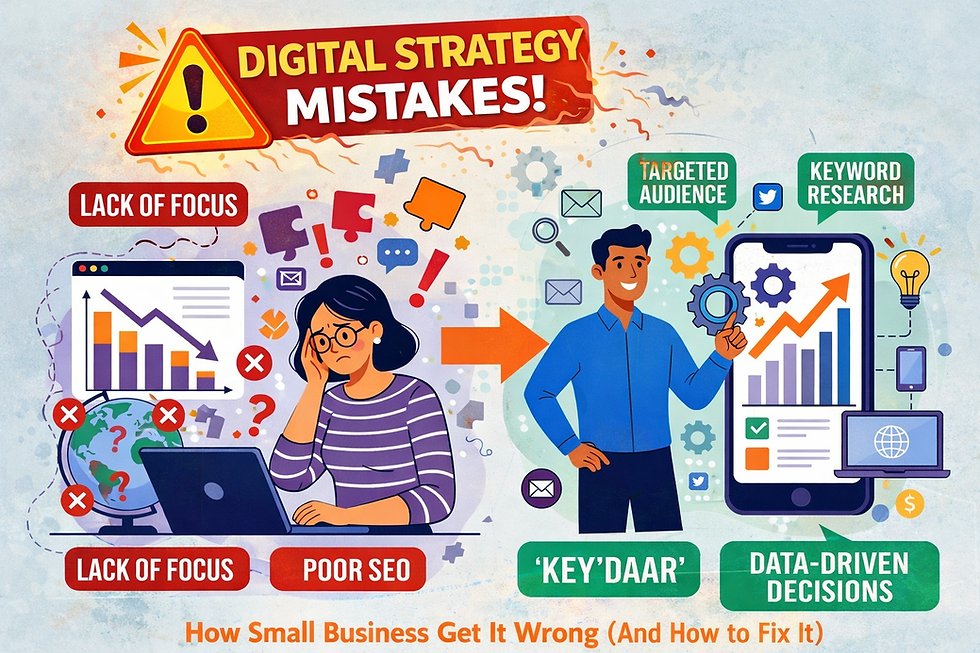
In the modern business landscape, "going digital" isn't just an option: it’s the foundation of survival.
Yet, for many small business owners, the digital world feels like a labyrinth of expensive tools, confusing jargon, and ever-changing algorithms. You know you need to be online, but there is a massive difference between having a digital presence and having a digital strategy.
With over 30 years of experience spanning commercial, technical, and creative sectors, I have seen firsthand how easily businesses can get lost. I’ve watched companies pour thousands into flashy websites that don't convert and social media ads that reach the wrong people.
The truth is, digital growth doesn't happen by accident. It requires a structured, practical approach that aligns your technology with your business goals.
If you feel like your digital efforts are stalling, you might be making one of these seven mistakes Small Businesses Make with Digital Strategy. Here is how to identify them: and more importantly, how to fix them.
1. Leading with Tactics Instead of Strategy
The most frequent mistake I encounter is the "Tactics First" trap.
This happens when a business decides they "need to be on TikTok" or "need to run Google Ads" before they have defined what they actually want to achieve. Without a roadmap, these efforts become isolated activities that drain your budget without moving the needle on your bottom line.
The Reason: It’s easy to get distracted by the "next big thing" in tech. However, a tool is only as good as the plan behind it.
The Solution: Step back and invest in professional digital strategy consulting. Before spending a penny on ads, define your core objectives. Are you looking for brand awareness, lead generation, or customer retention? Every digital action should serve a specific business goal.
2. Having a "Vague" Target Audience
If you try to speak to everyone, you end up speaking to no one.
Many small businesses fear that narrowing their focus will lead to missed opportunities. In reality, the opposite is true. Digital marketing is highly competitive; if your messaging is generic, it will be ignored.
The Reason: Broad targeting leads to high ad spend with very low conversion rates. You aren't reaching the people who actually need your solution.
The Solution: Create detailed buyer personas. Who are they? What keeps them up at night? What specific problem do you solve for them? Use these insights to tailor your content. When your audience feels like you are speaking directly to them, trust is built instantly.
3. Treating Your Website as a Static Brochure
Is your website a 24/7 salesperson, or is it just a digital business card gathering dust?
Many businesses invest in website design for small business and then never touch it again. In 2026, your website must be dynamic, fast, and optimized for conversion. If it takes more than three seconds to load or looks broken on a mobile phone, you are losing money every single day.
The Reason: A static site doesn't engage visitors. If there is no clear "Call to Action" (CTA), users will browse and leave without ever contacting you.
The Solution: Focus on user experience (UX) and lead capture. Ensure your site is mobile-responsive and built with a clear path to purchase. For local businesses, this is even more critical: check out why strong websites are essential in 2026.
4. Failing to Embrace Business Process Automation
Are you still manually entering data from your website into a spreadsheet? Are you sending the same "thank you" email manually 50 times a week?
Repetitive manual tasks are the "growth killers" of small businesses. They lead to human error, employee burnout, and a ceiling on how much you can actually scale.
The Reason: Many owners believe automation is too expensive or too complex for a small team. In reality, business process automation is now more accessible than ever.
The Solution: Identify the tasks you do every single day that don't require your unique creativity. Automate your invoicing, your lead follow-ups, and your appointment scheduling. By removing the "busy work," you free up your time to focus on high-level strategy and client relationships.
5. Operating Without a Centralised CRM
Where is your customer data? If the answer is "in my head," "in my email inbox," or "on various spreadsheets," you have a major bottleneck.
A lack of a clear CRM (Customer Relationship Management) system means you have no "single source of truth." You can't see the history of a client's interactions, you miss follow-ups, and you can't segment your audience for targeted marketing.
The Reason: Spreadsheet-based management works for two customers, but it breaks at twenty. It prevents you from providing a professional, seamless experience as you grow.
The Solution: Look into CRM implementation services. A well-set-up CRM allows you to track every touchpoint a customer has with your brand. It’s the engine that powers sustainable, scalable growth. When you know exactly where a lead is in their journey, you can close deals faster and with less effort.
6. Ignoring the Power of AI Automation
There is a lot of hype around AI, but behind the noise lies a suite of incredibly practical tools.
Ignoring AI automation for business in 2026 is like refusing to use a computer in the 90s. AI isn't here to replace your expertise; it's here to augment it. From drafting initial content to analyzing large sets of data, AI can give a small team the output capacity of a much larger corporation.
The Reason: Fear of the unknown or the "creepy" factor often stops business owners from experimenting with AI.
The Solution: Start small. Use AI to help with content brainstorming or to summarize long reports. If you want to see a tangible impact, read about how small businesses can use AI to save 10 hours per week. It’s about efficiency, not replacement.
7. The "Set It and Forget It" Mindset
Digital strategy is not a project with a finish line; it is a continuous cycle of measurement and optimization.
Many businesses launch a campaign or a new system and then never check the data. They don't know which keywords are driving traffic, which emails are being opened, or where users are dropping off in the sales funnel.
The Reason: Data can feel overwhelming. Without a structured way to look at it, it’s easier to just ignore the numbers and hope for the best.
The Solution: Establish Key Performance Indicators (KPIs). Check your analytics monthly. Which parts of your strategy are working? Which are failing? Use these insights to pivot. This data-driven approach is what separates successful companies from those that eventually fade away.
The Path Forward: Simple, Structured, and Scalable
Avoiding these mistakes doesn't require a million-pound budget or a team of fifty. It requires a shift in mindset from "reactive" to "strategic."
By focusing on a structured approach, you can turn your digital presence from a source of stress into your most powerful asset. Whether it’s through smarter CRM implementation services or exploring AI automation for business, the goal is always the same: to make your business run more smoothly and profitably.
Quick Summary Checklist:
✔ Strategy First: Define your goals before choosing your tools.
✔ Know Your Audience: Speak directly to their specific pain points.
✔ Optimize Your Site: Make sure your website is built to convert, not just look pretty.
✔ Automate the Boring Stuff: Use technology to reclaim your time.
✔ Centralize Your Data: Get out of spreadsheets and into a CRM.
✔ Embrace AI: Use modern tools to increase your team's capacity.
✔ Measure Everything: Use data to make informed decisions.
Digital transformation doesn't have to be overwhelming. With 30 years of experience helping businesses navigate these exact challenges, I specialize in creating practical, accessible strategies that actually work for small businesses.
If you’re ready to stop making these mistakes and start building a digital foundation that supports your growth, let’s talk.
7 Mistakes Small Businesses Make with Digital Strategy
Ready to streamline your business? Explore more about how we can work together at Nicola Lonie.


Comments